Garudasana: the Eagle, the Pose That Gathers the Mind

Silvia Ghigliazza
Yoga Teacher
You know those days when your mind is everywhere except where you are? A dozen tabs open, thoughts jumping from one thing to the next, and you can't seem to land on anything. Well, the eagle — Garudasana — was made for days like that. It asks one thing of you: gather yourself. Legs that wrap, arms that entwine, the gaze fixed on a single point. And suddenly, to stay balanced, the mind has only one thing to do.
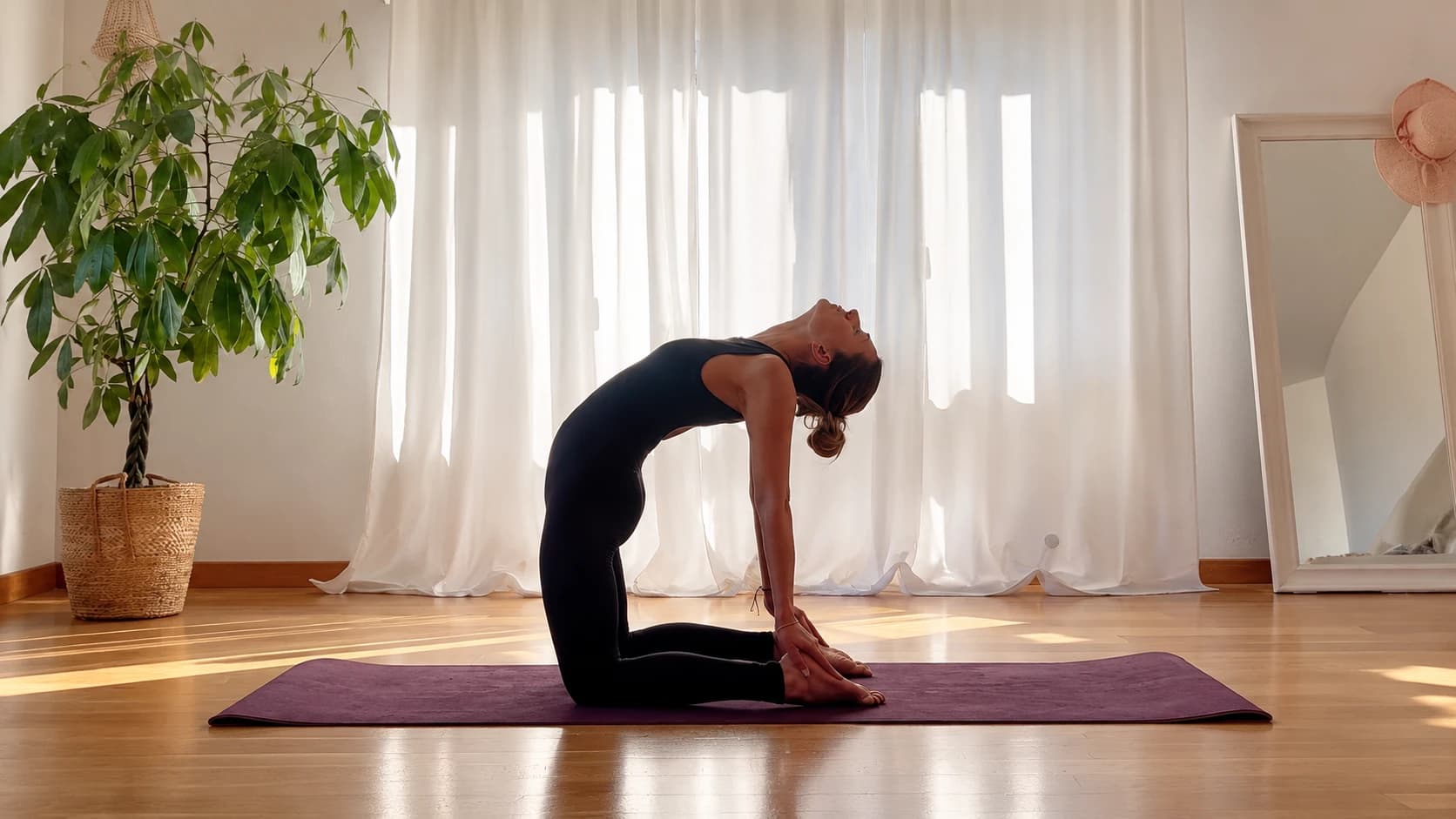
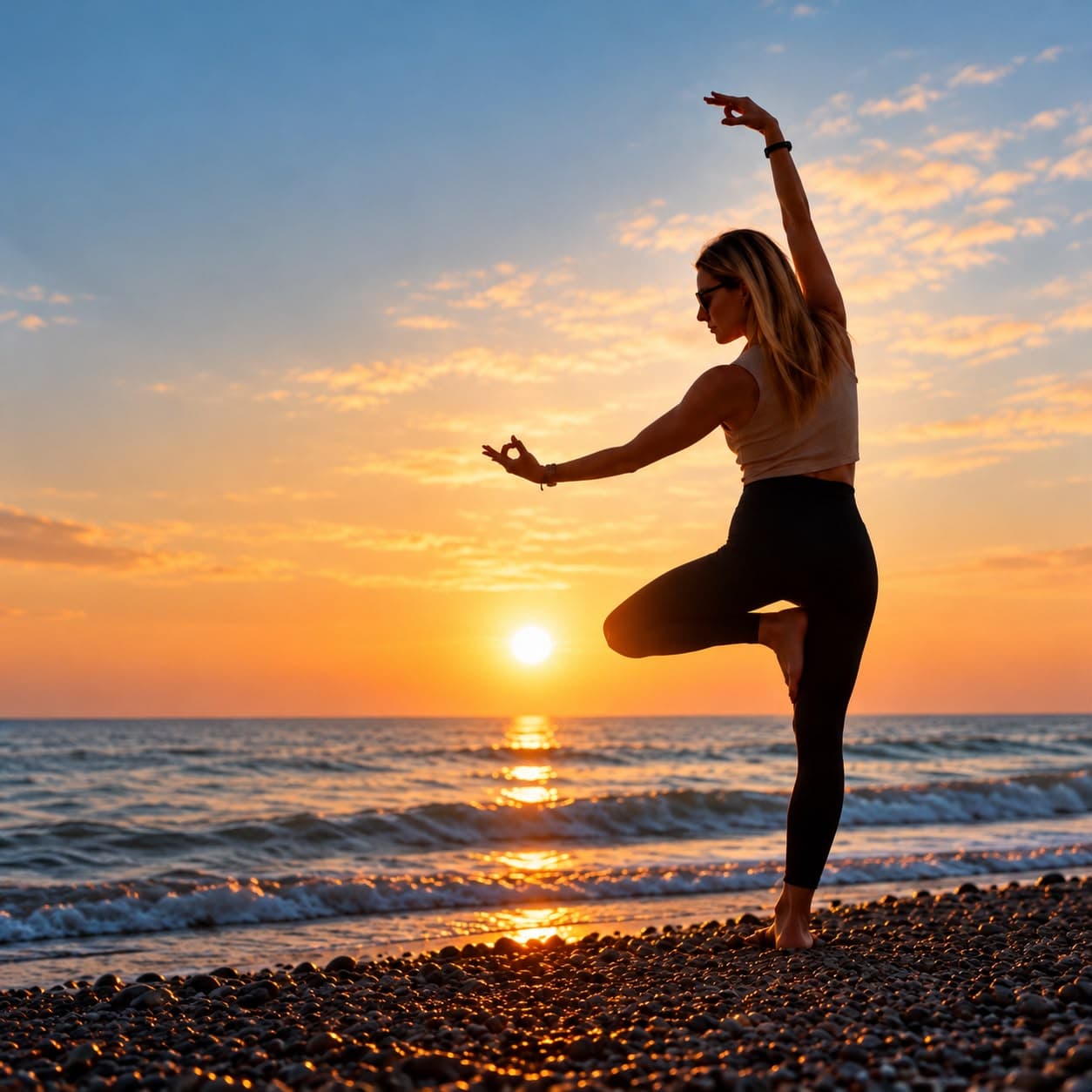
After the tree and the camel, today in the Library of asanas we return to balance — but on one leg and all «wrapped up». Garudasana is the pose of concentration: it looks like a knot, and it's actually the most elegant way yoga knows to bring you back to the present.
The name: what Garudasana means
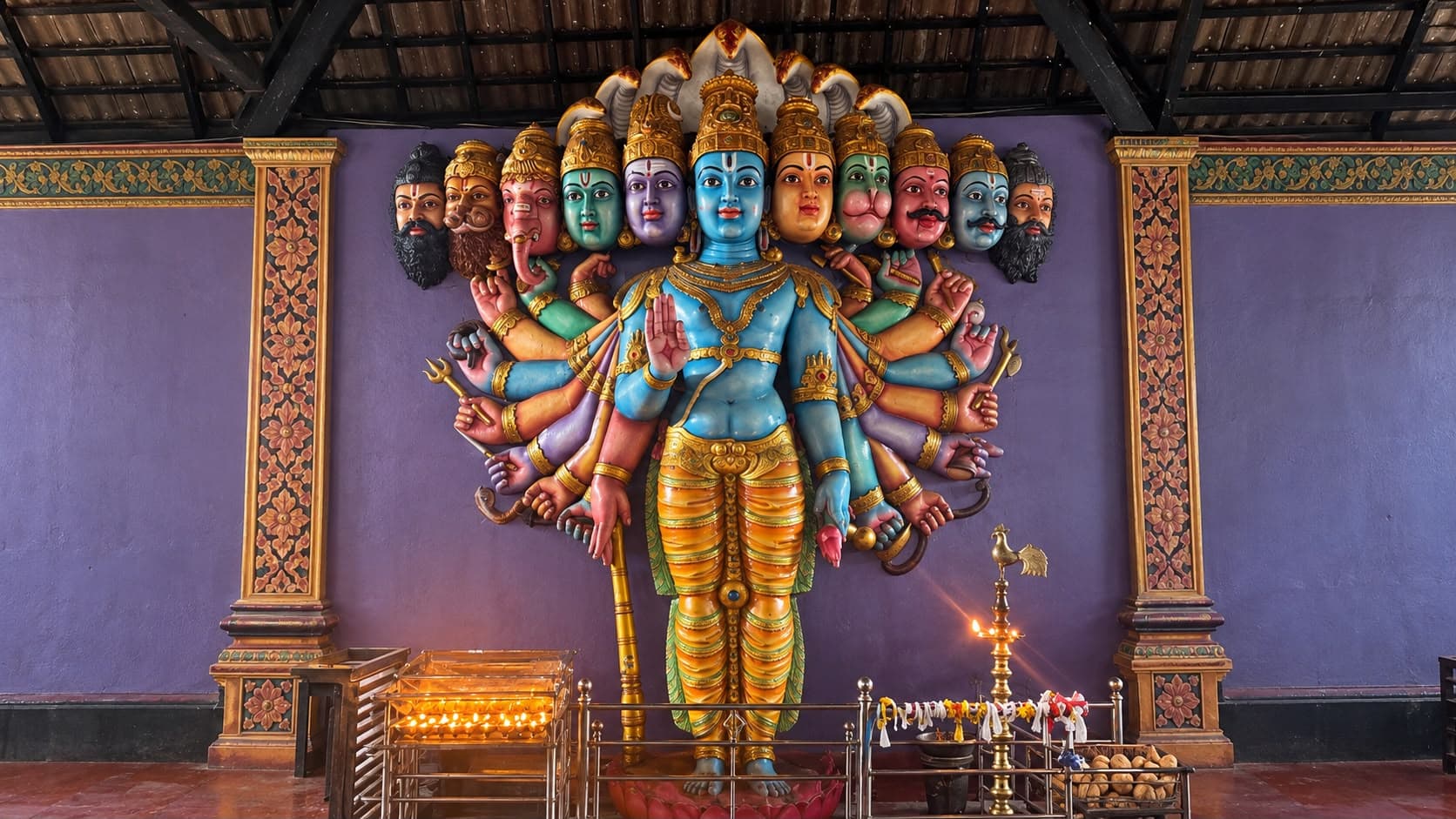
Here the name hides a surprise. Garuda isn't just any eagle: he is the divine eagle, king of all birds, the mount of the god Vishnu. Half man, half bird of prey, he is a powerful, radiant creature of Indian mythology. Asana is the pose: Garudasana is «the pose of Garuda». It's pronounced roughly ga-ru-DAHS-ana. In English we call it the «eagle» for simplicity — but remember that, on the mat, you're taking the shape of a king.
The symbol: gathering what is scattered
In the old stories Garuda is the sworn enemy of the naga, the serpents — and serpents, in yoga, are often the image of the mind that slithers, restless, impossible to catch. Wrapping yourself up the way this pose does is exactly that: gathering the energy that scatters in a thousand directions and bringing it to one point. The eagle sees far because it looks at one point. That's its whole lesson: concentration isn't effort, it's choosing where to rest your gaze.
How to get in, step by step
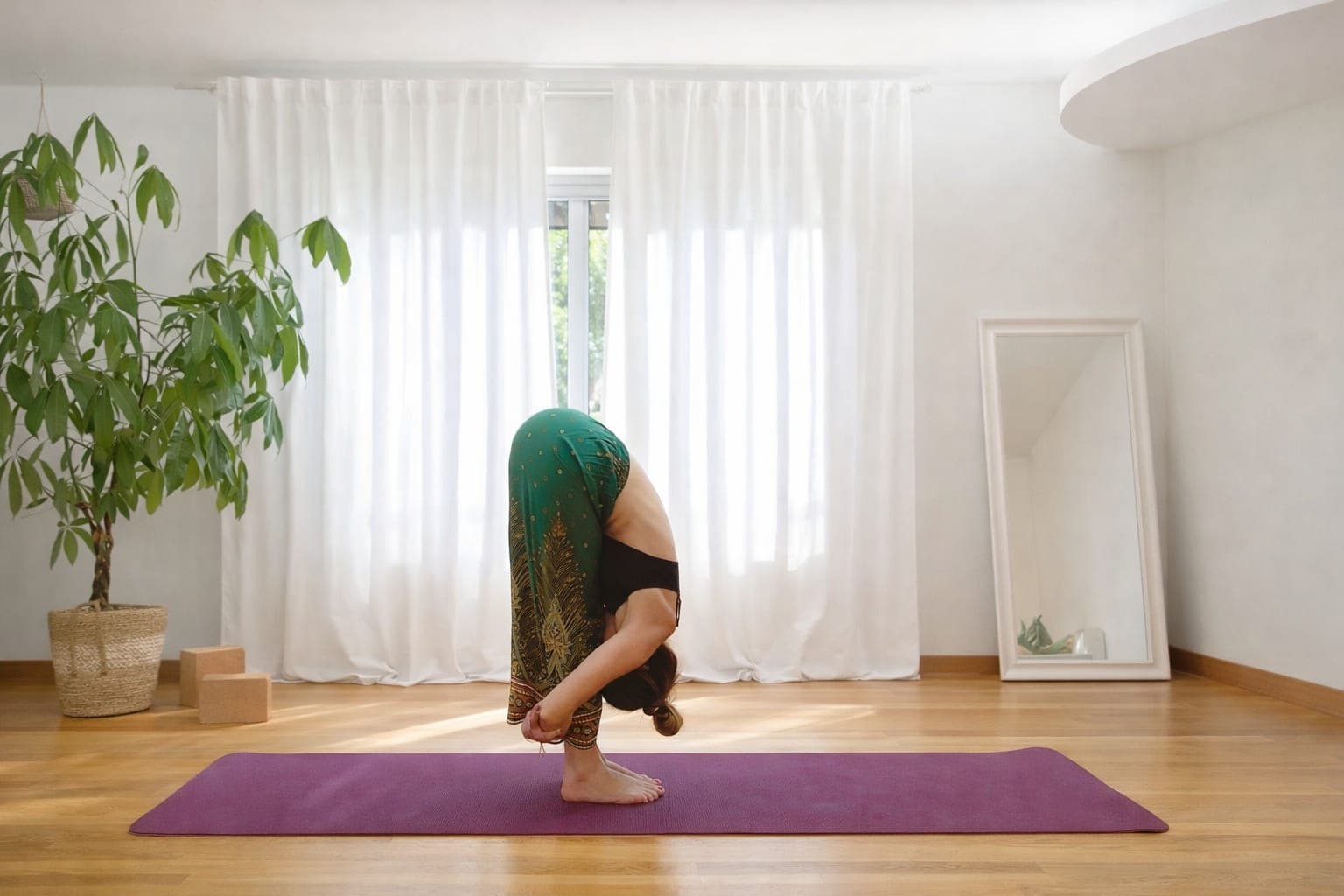
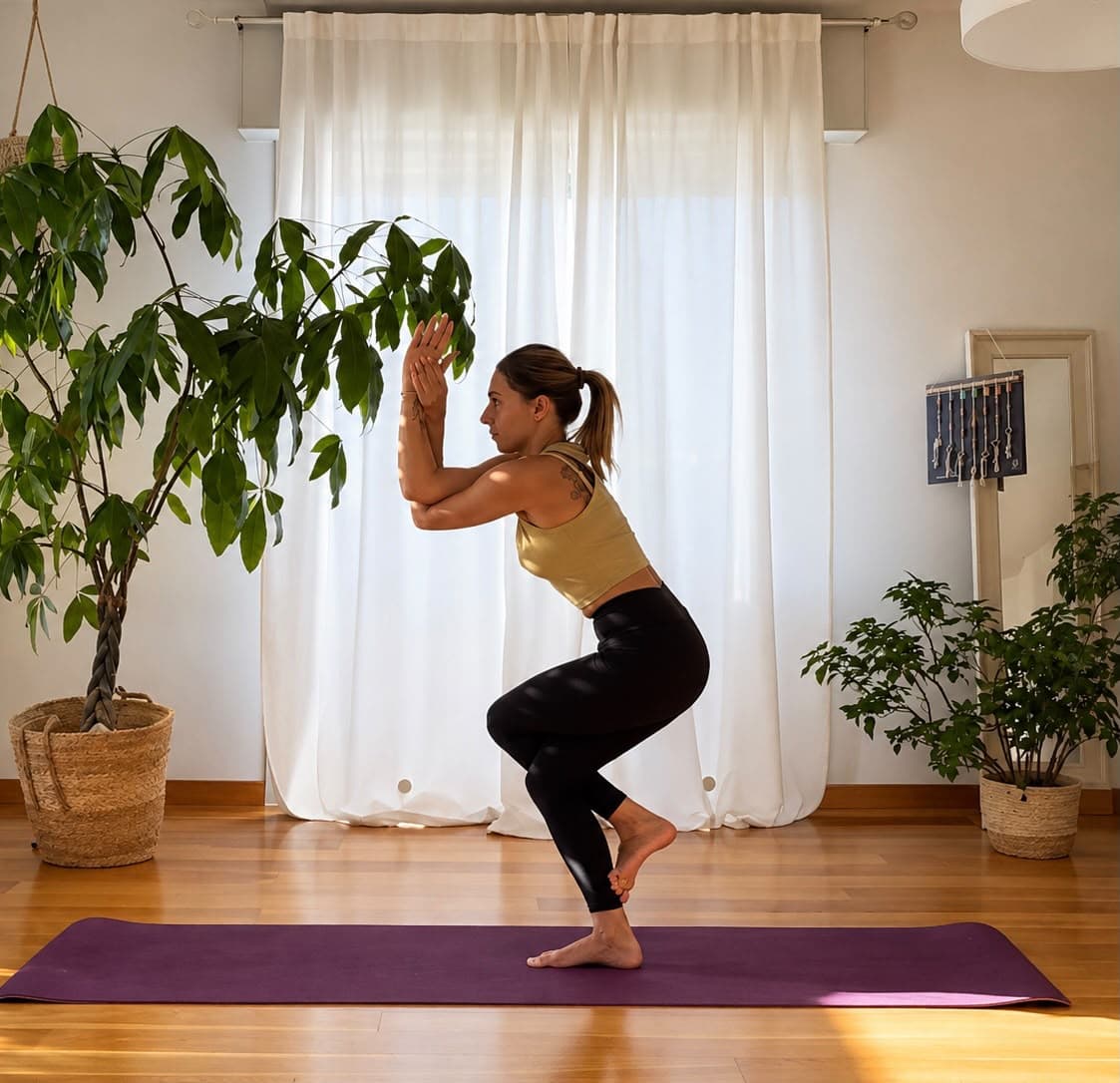
- ●Start standing, in Tadasana, and bend your knees slightly, as if to sit on an imaginary chair: stability is born here.
- ●Shift your weight onto the right leg. Lift the left and cross the left thigh over the right.
- ●If you can, hook the left foot behind the right calf; otherwise let the toes brush the floor — that works just as well.
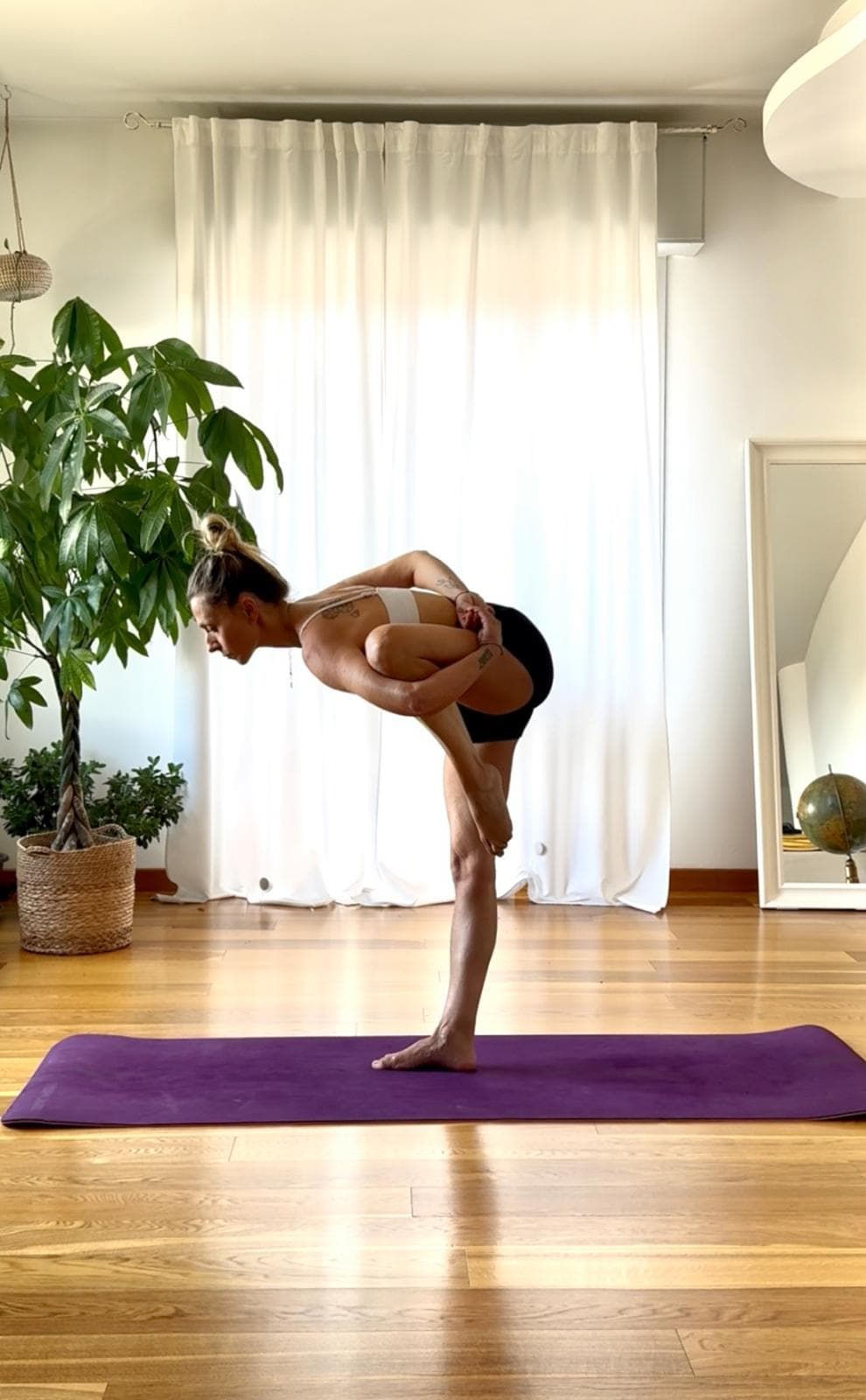
- ●Bring your arms in front of you and cross them at the elbows, the arm opposite to the top leg on top (if the left thigh is on top, the right arm goes on top); then wind the forearms and bring the palms to touch.
- ●Lift the elbows to shoulder height and move the hands away from your face: you'll feel the space between the shoulder blades open. Lengthen up through the spine as the hips sink.
- ●Choose a still point in front of you and rest your gaze on it (the drishti): balance lives there. Breathe, 3–5 breaths.
- ●To come out, slowly unwind arms and legs and return to Tadasana. Then repeat on the other side — because the eagle, like us, has two wings.
The 3 most common mistakes
- ●Looking down and holding your breath: that's when balance collapses. Keep your gaze fixed on one point and let the breath flow, slow.
- ●Forgetting to bend the standing leg and hiking the shoulders up to the ears: the pose turns rigid. Bend the knee, let the hips sink and draw the shoulders away from the ears.
- ●Forcing the foot to hook or the palms to meet: if you get there by force, you lose your centre. Stability first, then the wrap — the depth comes on its own, in time.
The benefits
- ●Trains balance, coordination and — above all — concentration: it's a standing meditation.
- ●Opens the area between the shoulder blades and the shoulders, the part that stiffens in front of a computer: the wrapping of the arms is a massage for the upper back.
- ●Strengthens legs, ankles and feet, and stretches the outer hips, often tight in those who sit a lot.
- ●Mobilises wrists and forearms and, by crossing arms and legs from one side of the body to the other, stimulates coordination between the two hemispheres.
- ●Calms the mind: to stay, you have to be here. And when you're here, thoughts stop jumping.
The variations, from the easiest to the most advanced
- ●Easier — cross only the legs, without hooking the foot, and rest the toes on the floor (or on a block) for an extra point of support. Practise near a wall if balance is new to you.
- ●For the arms — if the palms don't meet, hug yourself: each hand on the opposite shoulder, like a hug. The opening in the back is the same.
- ●Intermediate — full wrap of arms and legs, hips lower, elbows lifted to shoulder height.
- ●Advanced — from there, lean slowly forward bringing the elbows toward the top knee, a movement that releases and challenges your balance. Three levels of one pose: choose yours, today.
Who it's for (and who should take care)
The eagle is within almost everyone's reach in its version with the legs simply crossed. Go gradually and seek guidance in case of problems or recent surgery to knees, ankles, shoulders or wrists, and in pregnancy (where a supported version, without wrapping too much, is better). Always warm up ankles and shoulders first: joints like to be warned. And remember: falling out of balance isn't failing — it's how you learn to stay.
A curiosity
Garuda is so beloved that he has stepped out of the temples to become a national symbol: he is the emblem of Indonesia and gives his name to its flag carrier, Garuda Indonesia. Half man, half eagle, king of the skies and devourer of serpents, he represents the strength that overcomes restlessness. Not bad, for a pose that at first glance looks like one elaborate knot. Next time you wrap into Garudasana, remember you're taking the shape of a king of the skies — and stealing his secret: to look at a single point.
↗Another balance: the tree
If the eagle taught you to gather yourself, Vrksasana teaches you to root. Discover the tree pose, another pillar of the Library.
The Sanskrit names of the asanas
Garuda, vrksa, ustra... behind every name there's an image or a myth. The glossary to understand what you say each time you step onto the mat.
The eagle flies high because it looks far, and it looks far because it looks at a single point. Concentration isn't effort: it's choosing where to rest your gaze. — Silvia
Frequently asked questions
From Sanskrit Garuda (the divine eagle, king of birds and mount of Vishnu) + asana (pose): it's «the pose of Garuda», a standing balance on one leg in which arms and legs wrap around, gathering body and mind into one point.
It trains balance and concentration, opens the shoulders and upper back, strengthens legs and ankles, stretches the outer hips and mobilises wrists and forearms. It's a true standing meditation, perfect for anyone who spends hours at a computer.
The secret is the gaze: choose a still point in front of you and hold it. Bend the standing leg, let the hips sink and breathe slowly. Balance isn't in the muscles, it's in the attention.
Yes, in the version with the legs simply crossed and the toes on the floor (or near a wall). For the arms you can hug yourself, hands on the opposite shoulders. What counts is the focus, not the perfect knot.