Yoga on a Plane: the Practice You Carry Even at 30,000 Feet

Silvia Ghigliazza
Yoga Teacher
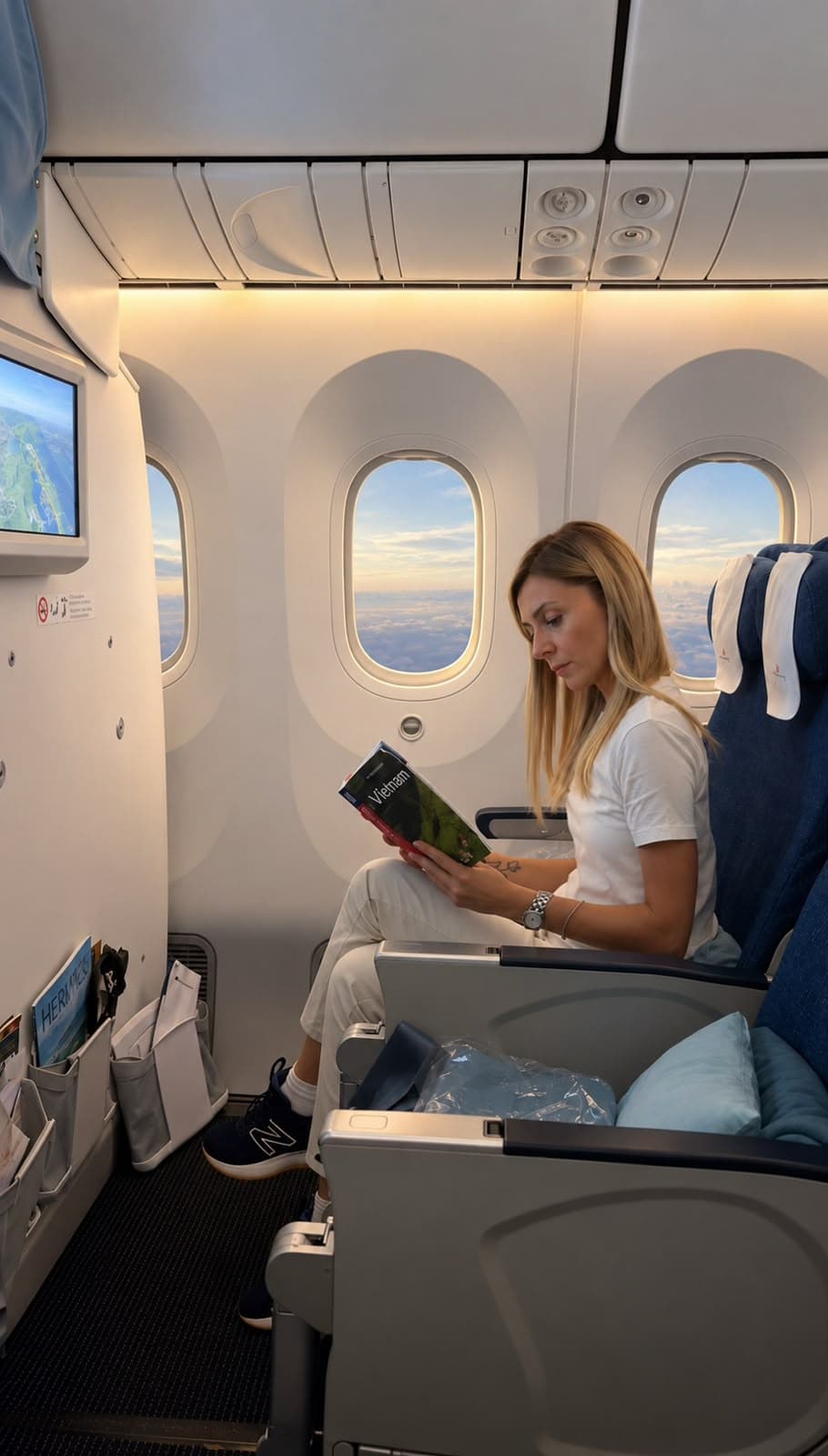
Eleven hours of flight. The window is dark, the film is over, your back stiffened long ago. You shift a couple of centimetres in your seat looking for a position that never comes, and you think: six hours to go. If you have ever faced a long-haul flight, you know this scene — and we usually accept it as an inevitable toll of travelling.
But what if part of those hours could be turned into something else? You don't need space, you don't need a mat, you don't even need to get up from your seat. Real yoga isn't the spectacular pose: it's coming back into the body and the breath. And that you can do anywhere — even squeezed into economy, with your neighbour asleep and the trolley going by.
It's the very meaning of being "the Yogini with the Suitcase": the practice doesn't stay home when you leave. It travels with you. And on a plane, where the body struggles most, it can become your best travel companion.
What happens to the body when you sit still for hours
The body isn't made to stay still, and a plane is perhaps the place where we forget it most. A few hours in the same position and the neck, shoulders and lower back start to stiffen; the legs grow heavy; the breath, without our noticing, gets shorter. Add the dry air, the constant noise, the suspended time — and that's why we often land more tired than when we left.
The good news is that small gestures, repeated, are enough to change things. You don't need complicated exercises: you need the right ones, done with attention. Here are three — the ones I use every single time I board a plane.
1. The breath: the simplest thing, and the most powerful
If you do one thing in flight, do this. The breath is the only tool you always carry with you, it disturbs no one and it's invisible: nobody will ever know you're practising.
The secret is to lengthen the exhale. Breathe in through the nose counting to four, then breathe out slowly — through the nose — counting to six, or to eight if it feels comfortable. An exhale longer than the inhale is what tells the body it can slow down: the heartbeat settles, the shoulders drop, the mind stops chasing. Five minutes like this, maybe at take-off or when unease rises, and you feel the difference. Never force it: if you run out of air, you've overdone it — make it shorter.
2. Three movements no one will notice
You don't have to stand up or invade your neighbour's space. These are done seated, in silence, with small gestures — but in the spots that suffer most in flight:
- ●The ankles. Lift your feet slightly and draw slow circles with your toes, first one way then the other. Still legs are the first to grow heavy: this simple movement wakes them up.
- ●The neck. Let your ear drop gently towards the shoulder and breathe there for a few moments; then change side. It's where the tension of hours spent looking at a screen too close collects.
- ●The chest. Rest your hands on your knees, lengthen your spine upwards and open the chest slightly, as if drawing the breastbone away from your lap. It counters that forward curling the seat imposes on us for hours.
Do one whenever you remember. It isn't the single pose that makes the difference: it's coming back to movement in small doses, instead of stiffening for eleven hours straight.
3. Close your eyes (and let yourself be carried)
There's one last thing, and it's the one that turns the flight from time to endure into time for yourself. Put on your headphones, choose a sound you like — slow music, a soundscape, even the white noise of the engines works fine — close your eyes and bring your attention to the breath. You don't have to "empty your mind": you just have to rest it somewhere. Every time it wanders off, you bring it back to the breath. Gently, a thousand times if needed.
It's mindfulness, and it's the simplest way not to arrive with your head in a thousand pieces. A few minutes like this, repeated during the flight, and you step off the plane more centred, less drained, with less of that confused discomfort we call jet lag — ready to actually live the place you've reached, instead of having to recover first.
An idea I'm carrying higher
Let me tell you something. By practising on planes, trip after trip, I began to bring order to all of this: a real little routine designed for the cabin, where every gesture, every breath and every moment of quiet is in the right place. It's a project I'm working on with care, and one I'd love to see accompany travellers one day, right up there among the clouds. But that's another story, and I'll tell it in good time.
In the meantime, if you want to travel prepared, I've put together a small guide with my routine for long flights — the one I actually use. Write me "VOLO" and I'll send it to you before your next departure: carry it with you and open it when the window goes dark and there are still six hours to go.
↗Request the "Yoga on a Plane" mini-guide
Write me VOLO and I'll send you my routine for long flights: breath, movement and presence to land lighter.
Frequently asked questions
Yes, and it's designed exactly for that. None of these gestures require standing up or taking up space: breath and the ankle, neck and chest movements are all done seated, without disturbing the person next to you.
No. There are no difficult poses to learn: they are simple, natural gestures. If you've never done yoga, a flight can even be a gentle way to discover how much the breath matters.
A little at a time, at several points: a few breaths at take-off, the movements whenever you feel the stiffness coming, the quiet part when you want to rest. Small repeated doses work better than one long session.
Slow breathing is one of the most effective tools for easing unease: lengthening the exhale helps the body feel safer. It's no substitute for specific support if the fear is strong, but for the tension of the difficult moments it's a precious ally.
Yoga isn't the mat or the perfect pose. It's the breath that brings you home, wherever you are — even at thirty thousand feet. — Silvia