Yoga for Better Sleep: Your Evening Routine

Silvia Ghigliazza
Yoga Teacher
It's eleven at night. You're in bed, exhausted, and yet your mind won't switch off: the to-do list, the messages, the phone lighting up the dark. You turn over, check the time, count how many hours you have left — and the more you think about it, the less sleep comes. If this sounds like you, you're in very good company: sleeping too little and badly is one of the ailments of our age.
The good news is that you don't need anything complicated. Ten minutes of gentle practice, always the same, are enough to tell your body one simple thing: «it's time to switch off». Because sleep can't be forced — it can only be prepared for.
Why yoga helps you sleep
Inside us live two switches. One is the accelerator — the sympathetic nervous system — the one for running, working, worrying. The other is the brake — the parasympathetic — the one for rest. In the evening we often keep the accelerator pressed: screens, thoughts, rush. Evening yoga does one precise thing: it presses the brake. Gentle poses held for a while and, above all, slow breathing with a longer exhale switch on those relaxation sensors that lower your heart rate and tension and open the door to sleep.
The 10-minute evening routine
You can do it on a mat or straight on your bed, with the lights low and your phone far away. No performance: move slowly, hold each pose for about a minute (8-10 slow breaths) and let your body settle. Here's the sequence:
- ●Child's pose (Balasana) — kneeling, forehead on the floor, arms soft alongside you. It releases back, neck and shoulders and brings an immediate sense of coming home to yourself.
- ●Reclining bound angle (Supta Baddha Konasana) — lying down, soles of the feet together and knees open, hands on your belly. It opens the hips and slows the breath.
- ●Reclining twist (Supta Matsyendrasana) — on the floor, drop your knees to one side and your gaze to the other, then switch. It releases the spine and the day's tension.
- ●Legs up the wall (Viparita Karani) — lying down with your hips near the wall and legs resting up. It's the queen of evening relaxation: it lightens the legs and slows everything down.
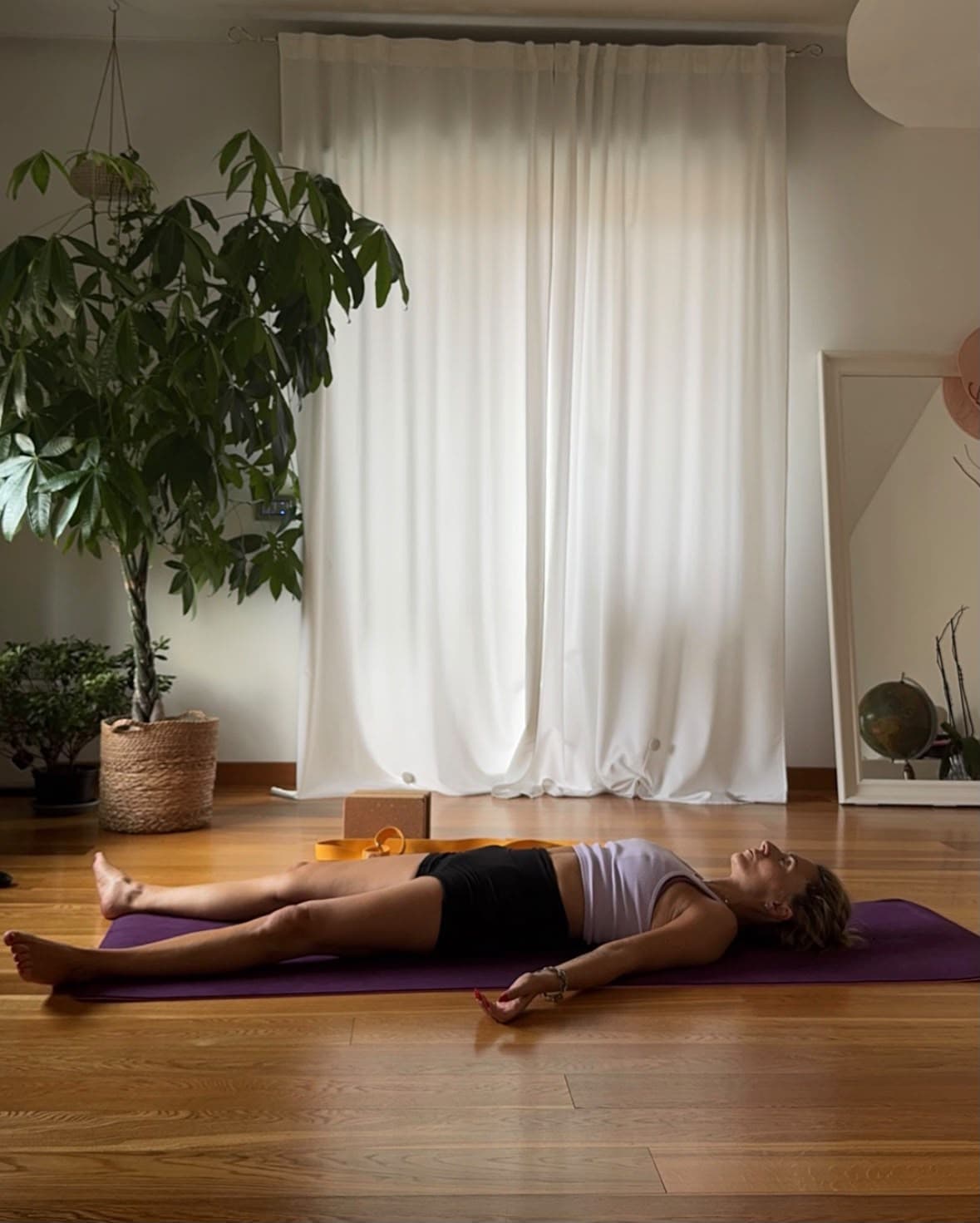
- ●Final relaxation (Savasana) — on your back, arms soft, eyes closed. Stay a few minutes and move on to the breath below.
The breath that switches off the mind
This is the heart of the whole routine. Lying down, close your eyes and lengthen the exhale: breathe in through the nose for a count of 4, breathe out slowly for a count of 6 (or try 4-7-8: in for 4, hold for 7, out for 8). When the exhale is longer than the inhale, the body understands it can let go. Repeat for 8-10 breaths — or until you lose count, which is exactly the point.
Small habits that make the difference
- ●Turn off screens at least half an hour before: blue light tells the brain it's still daytime.
- ●Dim the lights after dinner: warm, soft light prepares you for sleep.
- ●Go to bed at roughly the same time: the body loves rhythms.
- ●Keep the bedroom cool, dark and quiet.
- ●Avoid coffee and intense workouts in the evening: they keep the accelerator pressed.
One last thing, the most important: consistency beats perfection. This routine works if it becomes a small ritual, a few evenings a week. It doesn't have to be long — it has to be yours.
↗If anxiety is keeping you awake
Often it's the mind on alert that steals your sleep. Here you'll find a breath to do right now and the practices to calm anxiety and stress.
Why you can't switch off
If you reach the evening unable to slow down, this article explains why it happens and what truly helps the body ease off.
Sleep isn't something you win by force: it's something you surrender to. And surrendering, in the evening, is a small act of love towards yourself. — Silvia
Frequently asked questions
The most effective are the gentle ones held for a while: child's pose, reclining bound angle, reclining twist, legs up the wall and the final relaxation (Savasana), with slow breathing and a longer exhale. Avoid intense practices, backbends and inversions, which switch the body on.
Any time in the 30-60 minutes before bed, with the lights low, works well. Ten minutes are enough: the aim isn't to tire you out, but to slow down and signal to the body that the day is over.
Yes. Many of these poses — reclining bound angle, twist, the final breath — are comfortable on the mattress. For legs up the wall you can rest them on the headboard or a wall near the bed.
Evening yoga and slow breathing help create the right conditions to fall asleep and often improve sleep quality. They don't replace medical advice: if insomnia is persistent, talk to your doctor — but in the meantime this routine is a great ally.