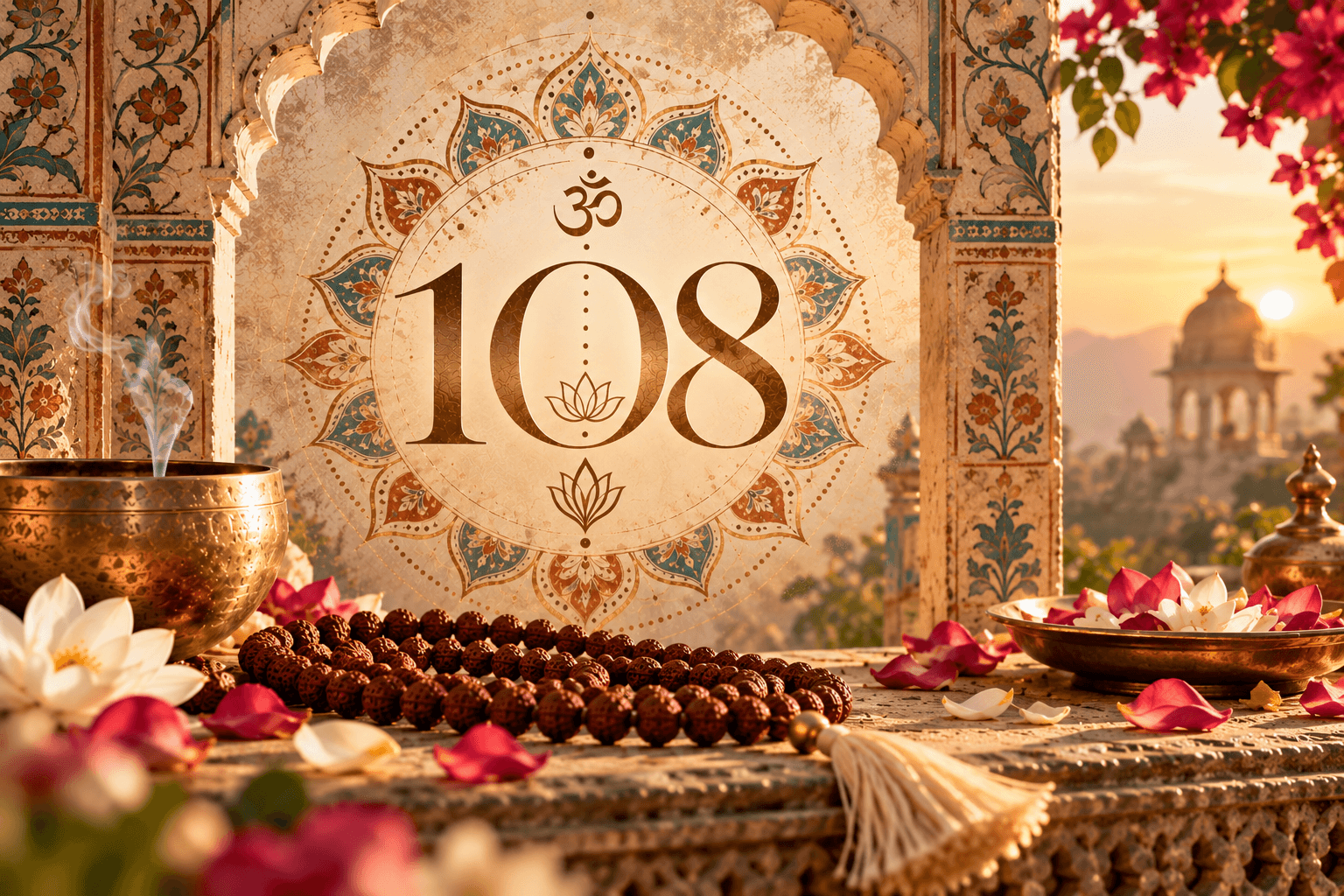
108: The Sacred Number of Yoga

Silvia Ghigliazza
Yoga Teacher
If you practise yoga, sooner or later 108 shows up in front of you. It's the number of beads on a mala, the number of sun salutations repeated at the turn of the seasons, the sign that towers over the stage at certain festivals. It comes back, again and again. Until at some point you ask yourself: but why this number?
There isn't a single answer, and that's exactly the beauty of it. 108 is perhaps the most beloved number in yoga and in the whole of Indian tradition, and it runs through its texts, its way of looking at the sky, its idea of the body. I've tried to gather it all here in a simple, orderly way — because you don't need to be an expert to be moved by it — yet complete enough to come back to whenever that number reappears on your path.
Where you meet 108
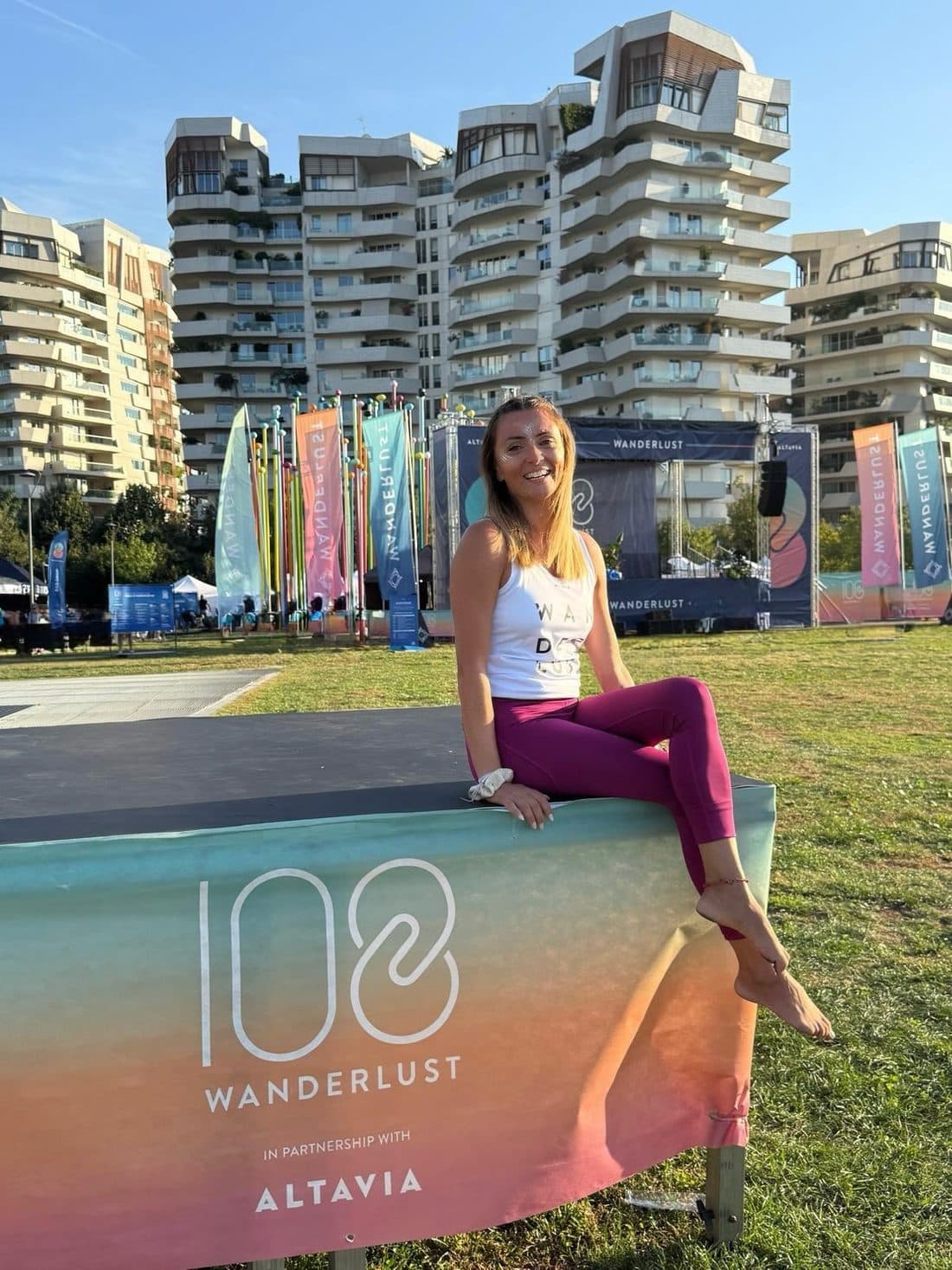
Before we understand where it comes from, let's look at where it lives today. You'll find it on the mala, the meditation necklace, which has exactly 108 beads. You'll find it in the 108 sun salutations that so many teachers offer at the year's important passages. You'll find it in the names of wellness events and festivals. And you'll find it in mantras, often recited precisely 108 times. It's as if tradition had chosen this number as its signature.
The origins: an ancient number
108 has its roots in Vedic culture, the very one from which yoga itself was born thousands of years ago in India. There is no single date or one text where it first appears: it's rather a number that recurs, like a musical motif, across different fields — astronomy, sacred geometry, spirituality — until it became a shared symbol of wholeness and cosmic order. The ancients saw it as a number able to contain everything: the sky, the earth, and the one who observes them.
108 in the sacred texts
It's above all in the texts of the tradition that 108 takes shape. The Upanishads — the philosophical writings at the root of yogic thought, exploring the relationship between the individual soul and the absolute — number, according to the best-known canon (the Muktika), exactly 108. Not a random figure, but one chosen precisely to say completeness.
From there 108 multiplied everywhere in devotion: 108 are the names by which the deities are invoked, 108 the sacred sites (the pithas) that draw pilgrims, 108 — in tradition — the companions of Krishna. Reciting a name, or a mantra, 108 times is considered a way to complete the circle, to say all there is to say.
The meaning: one, void, infinity
There's a reading, simple and beautiful, that starts from its three digits. The 1 is unity: the beginning, that which is one, the consciousness from which everything originates. The 0 is emptiness and fullness at once: the silence, the space from which all things are born. The 8, lying down, is the symbol of infinity: that which has no end. One, void, infinity — 108 holds the entire spiritual journey in three signs: from the self, through silence, toward something without boundaries.
108, the sky and the numbers
One of the most fascinating hints comes from astronomy. It's said that the distance between the Earth and the Sun is about 108 times the Sun's diameter, and that the same holds, almost by magic, for the Moon in relation to the Earth. These are approximate measures, and that's not the point: what strikes us is the idea that this number connected, in the eyes of the ancients, the body of the practitioner with the rhythm of the cosmos. A bridge between the small and the immense.
There's more, and it concerns pure numbers. In Vedic astrology the 9 planets multiplied by the 12 signs give 108; and the 27 lunar constellations (the nakshatras), each divided into 4 quarters, again give 108. Even the Sanskrit alphabet, with its 54 letters read in masculine and feminine form, reaches 108. And there's a small mathematical wonder: 1 to the power of 1, times 2 to the power of 2, times 3 to the power of 3 — that is 1 × 4 × 27 — equals exactly 108. As if the number wanted to remind you, from every direction, of the same thing: here the whole is held.
108 in the body
The number isn't only about the sky, but also about the subtle body — the one yoga speaks of when it describes the energy that runs through us. Tradition tells of 108 nadis, the energy channels, converging in the heart, in the centre called anahata. And Ayurveda, the ancient Indian medicine, describes 107 marma points, the vital points of the body: some consider the mind the 108th, the last, the one that holds all the others together. Here too, 108 is the number of completeness.
The mala: 108 beads to meditate
The place where 108 becomes a daily gesture is the mala. It's the necklace — or bracelet — used to count the repetitions of a mantra during meditation, a practice called japa. The beads are 108, plus one: the guru bead, a little larger, from which you start and to which you return without ever crossing it, as a sign of respect. Sliding the beads between your fingers, repeating a sound, is the simplest way to bring the mind back to the present: when you reach the 108th, you've closed the circle.
The 108 sun salutations
Then there's a way in which 108 becomes pure practice: the 108 sun salutations. By tradition they're performed at the year's passages — the solstices, the change of seasons — as a rite to close one cycle and open another. It's not a test of endurance: it's a meditation in movement. Repeating the same gesture so many times slowly quiets the chasing mind, and at a certain point it's no longer you doing the salutation: it's the salutation doing you.
All the 108s of yoga: the list
Have you ever wondered how often 108 really returns? I've gathered here, in a single glance, all the places this number appears in yoga and in Indian tradition. Keep it as a little map: each of these entries can become, on its own, a journey.
- ●108 beads on the mala, the meditation necklace — plus one, the guru bead.
- ●108 Upanishads, the philosophical texts at the root of yoga (the Muktika canon).
- ●108 nadis, the energy channels that converge in the heart (anahata).
- ●108 vital points: 107 marma in Ayurveda, plus the mind as the 108th.
- ●108 sun salutations, practised at the solstices and the change of seasons.
- ●108 repetitions of a mantra, to complete a cycle of meditation (japa).
- ●108 names used to invoke the deities, from Shiva to Vishnu to the Goddess.
- ●108 sacred sites (pithas), destinations of pilgrimage.
- ●108 gopis, Krishna's companions in tradition.
- ●108 karanas, the poses of Shiva's sacred dance (Natya Shastra).
- ●54 letters of the Sanskrit alphabet, in masculine and feminine form: 54 × 2 = 108.
- ●9 planets × 12 zodiac signs = 108, in Vedic astrology.
- ●27 lunar constellations (nakshatras) × 4 quarters (padas) = 108.
- ●1 × 4 × 27 = 108: the little mathematical wonder of 1¹ × 2² × 3³.
- ●About 108 times the Sun's diameter: that's roughly its distance from the Earth (and it holds for the Moon too).
- ●108 desires to overcome in the Buddhist tradition — hence the 108 tolls of the bell.
Why it matters in your practice today
You don't need to believe in numerology to be touched by 108. Its value, today, is above all an invitation: to repetition as a form of presence, to the intention with which you sit on the mat, to the idea that each practice is a circle that closes. Next time you meet it — on a mala, in a class, on a festival stage — you'll know it's not just any number. It's a small reminder: you are part of something greater, and complete.
↗Have a question about yoga? Write to me
Is there an aspect of yoga's philosophy or origins you're curious about and would love to explore? Tell me: the best questions will become the next articles on the blog.
Frequently asked questions
Because it recurs throughout Indian tradition as a symbol of completeness and union with the whole: there are 108 Upanishads in the Muktika canon, 108 names of the divine, 108 beads on the mala. It has no single origin, but a set of meanings that have accumulated over the centuries.
There is no single text that introduces it: 108 emerges in the Vedic culture of ancient India and recurs across different fields — the sacred texts, astronomy, the description of the subtle body — until it became a shared symbol of wholeness.
The mala is used to count the repetitions of a mantra during meditation (japa): 108 beads correspond to 108 repetitions. There is almost always one extra bead, the guru bead, which marks the beginning and end of the round and is not crossed.
A common reading sees in the 1 unity and the beginning, in the 0 emptiness and fullness, in the 8 (lying down) infinity. Together they tell the spiritual path: from the self, through silence, toward that which has no end.
They are a sequence of 108 sun salutations practised by tradition at the change of seasons or the solstices, as a rite of passage. More than a physical challenge, it's a meditation in movement: the repetition brings the mind to the present.
108 isn't a number to understand, but to feel: it's the way tradition reminds us that we are part of something greater. — Silvia