Diwali, the Festival of Lights: When Light Overcomes the Dark

Silvia Ghigliazza
Yoga Teacher
You know that feeling, when you light a candle in a dark room, and suddenly everything looks softer, more liveable? The dark doesn't vanish: it stays there, around you. But it stops frightening you. There's a whole festival built around this simple gesture — lighting a flame at the darkest point of the year. It's called Diwali.
This year it falls on Sunday 8 November. As you read these lines there are only a few days to go: just the right time to understand what is celebrated and, if you like, to light your own small flame too.
What Diwali is
The full name is Deepavali, from the Sanskrit dipa, «lamp», and avali, «row»: the row of lights. From there, in the most common pronunciation, Diwali. It's the most loved and deeply felt festival in India, and its heart is a single image: light overcoming darkness. Not only the darkness of night — also the one we sometimes carry inside. One of the oldest prayers asks «tamaso ma jyotir gamaya», «lead me from darkness to light»: it's knowledge dissolving ignorance, the awareness that brings light where before there were fear and confusion. Diwali is this wish, turned into a festival.
When it falls, and why it changes every year
If you've noticed that Diwali never has the same date, you're not wrong. The Hindu calendar is lunisolar: it follows both the sun and the moon together. The festival falls on the new-moon night — amavasya — of the month of Kartika, between mid-October and mid-November. The darkest night of the lunar month, chosen on purpose: it's exactly when the sky offers no light that more of it is lit on earth. In 2026 that night is Sunday 8 November.
The story: the return of Rama
Behind the lights there's an ancient story, told in the Ramayana, one of India's great poems. Prince Rama is sent into exile for fourteen years. During that exile the demon-king Ravana abducts his wife Sita and takes her to his kingdom, Lanka. A long war follows, which Rama eventually wins, freeing Sita. When he finally returns home, to the city of Ayodhya, it's a new-moon night: pitch dark. And so the people do something very simple and moving — they light rows of oil lamps along the streets, on the windowsills, in front of the doors, to light his way. That row of lights is the first Diwali. From then on those lamps are lit again every year: not only to remember a distant homecoming, but to say that even the thickest darkness, sooner or later, ends.
For me, this story hasn't stayed on the page. I was recently in Sri Lanka — the island many identify with the very Lanka of the tale, Ravana's kingdom — and there I felt my roots sink truly into the Ramayana. Walking through a place that still lives inside a poem thousands of years old changes the way you read it: it's no longer distant mythology, it's ground beneath your feet.
Not a single story
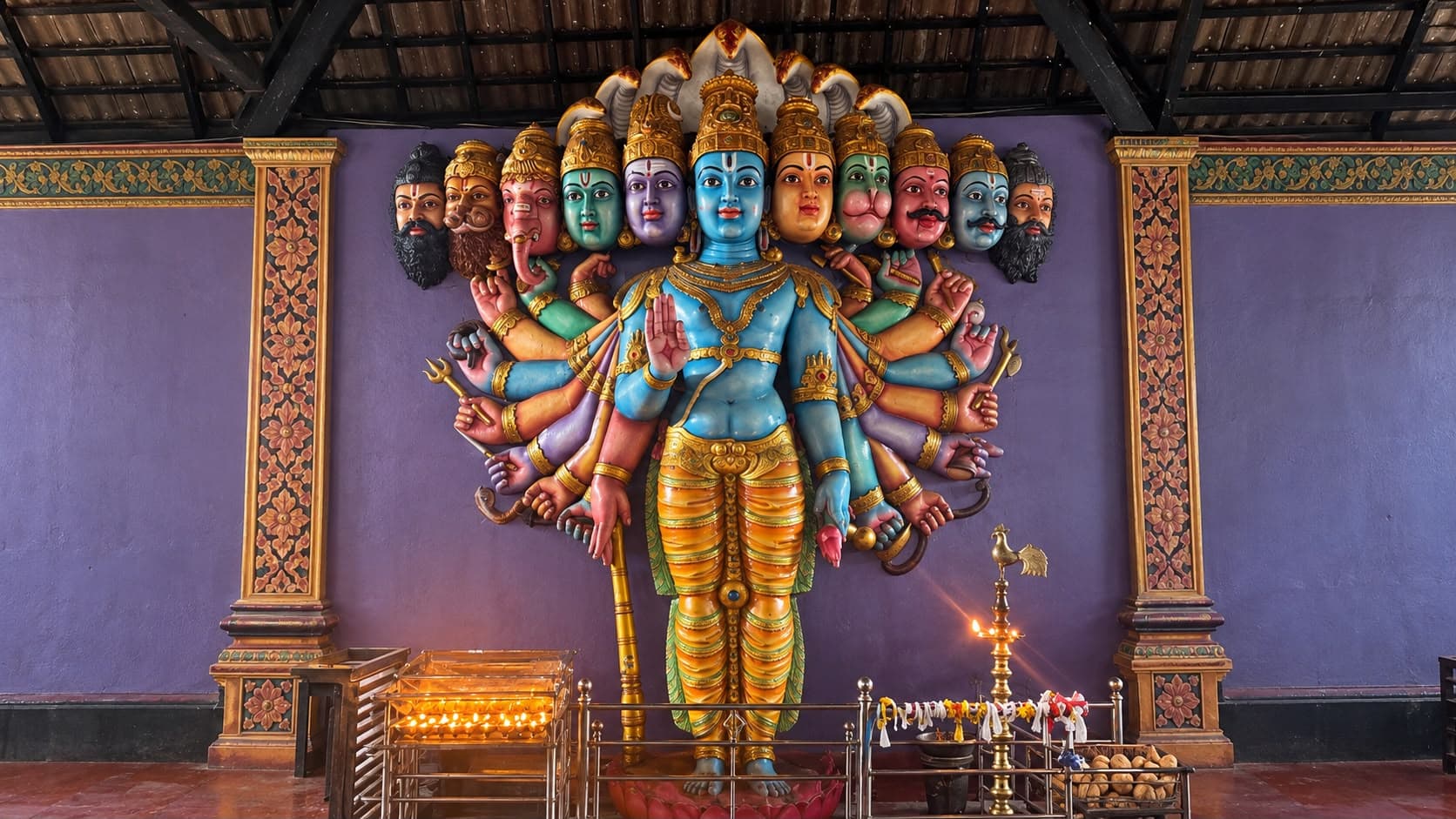
The beauty of Diwali is that it doesn't have just one story. In the south of India people remember above all Krishna's victory over the demon Narakasura: another light defeating another shadow. Across much of the country the central night is dedicated to Lakshmi, the goddess of abundance and prosperity: doors and windows are opened so she can enter, bringing fortune for the new year. And there are those who, like Jains and Sikhs, in these same days keep observances of their own, tied to their history. Different traditions, different tales — but underneath, always the same message: light has the last word.
How it's lived in India
Diwali isn't one evening, but five days. It begins with Dhanteras, dedicated to prosperity, when by tradition something new is brought into the home. It reaches the central night, Lakshmi Puja — 8 November in 2026 — the heart of the festival. And it continues with other days devoted to family, up to the bond between brothers and sisters of Bhai Dooj. The exact dates of the minor days shift a little from region to region: the fixed point is the new-moon night.
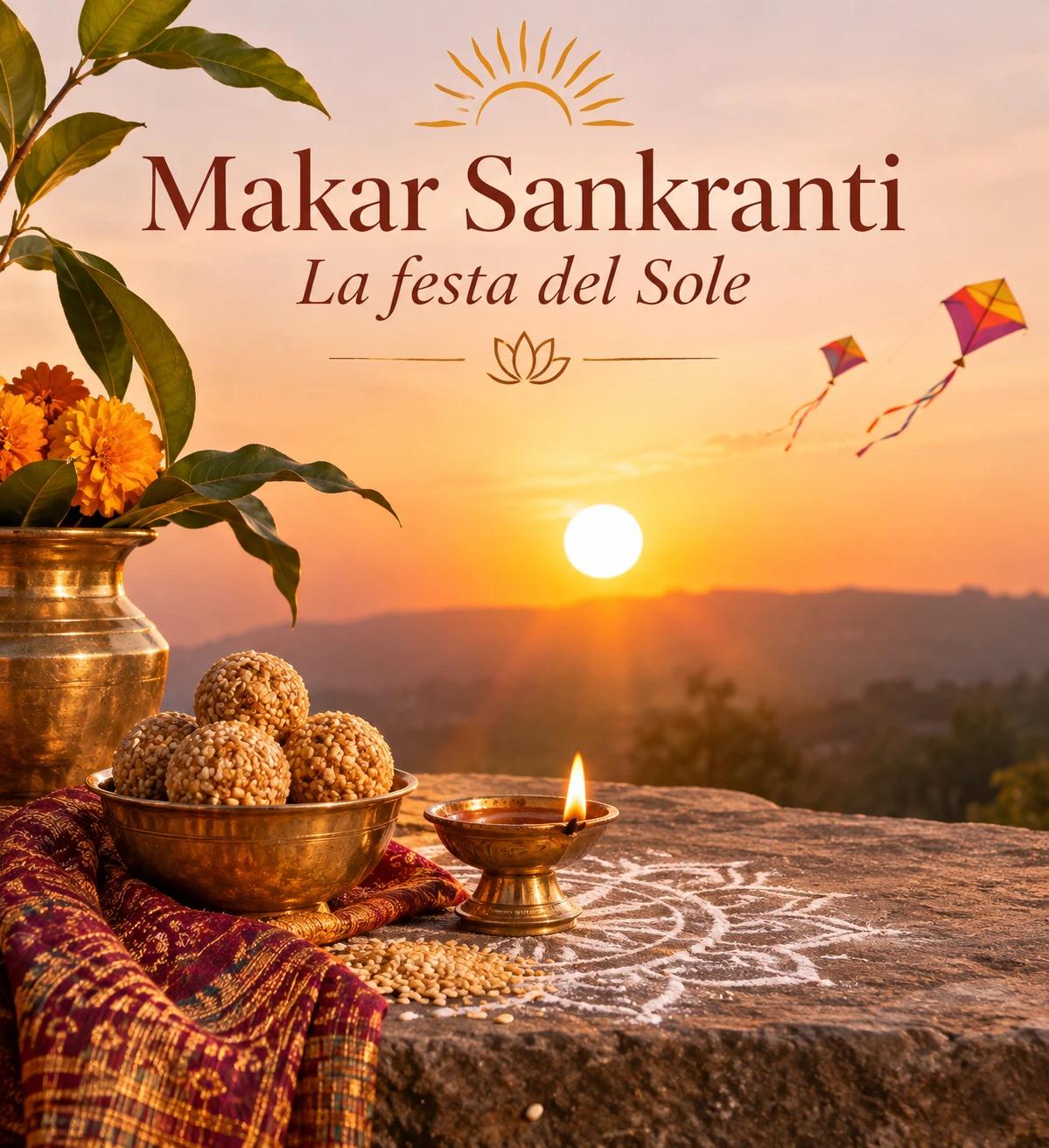
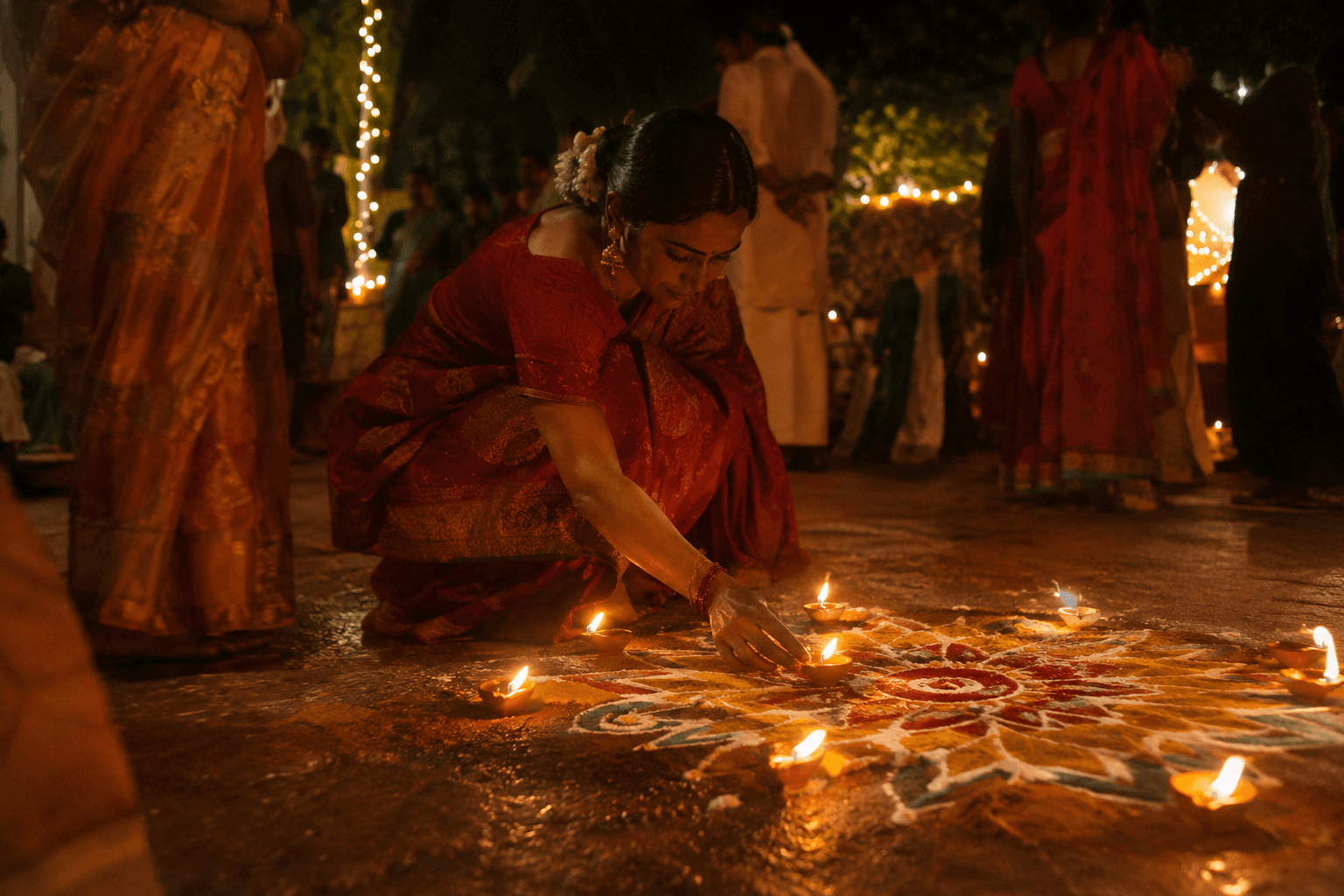
In the days leading up, homes are cleaned and renewed from top to bottom: space is made, literally, so that light and fortune can find room. On the threshold appear the rangoli, brightly coloured designs made with powders, petals and rice, like a welcome. At sunset the diya are lit, small terracotta lamps filled with oil, lined up on balconies and windowsills. Then the sweets, the fireworks filling the sky, the gifts, the houses full of relatives. In the air mingle the scent of freshly fried sweets, the smoke of the lamps and, after dusk, the crackle of fireworks: you feel Diwali before you even see it. It's a festival of open thresholds and of people coming together.
Diwali today, and here
Today Diwali has travelled far beyond India. Indian communities carry it with them everywhere, and in many big cities — from London to New York — there are now public celebrations, streets and buildings lit for the occasion. One important thing, though, needs saying: Diwali is a living religious and cultural festival, not a wellness trend. We can let ourselves be inspired by its most universal image — lighting a flame, making order, starting again — without turning it into a costume that isn't ours. It's not about imitating, but about being inspired: welcoming an ancient gesture with respect, knowing where it comes from. And perhaps it's no coincidence that a message like this speaks to us too right now, in autumn: it's the season when the days shorten and the dark comes early, and lighting something — a candle, an intention — becomes almost a need.
A small ritual of light, at home
In yoga there's a practice of concentration on a flame — it's called trataka — that has more than one thing in common with Diwali. I won't explain it here: it deserves an article of its own, and it will come. Just one word of caution, because light is to be handled with care: if you have eye problems or are sensitive to light, do it only with a teacher's guidance.
What you can do tonight, or during the days of Diwali, is a small, simple ritual. An idea, nothing complicated:
- ●Choose a corner and tidy it. Even just a shelf, a bedside table. Making space outside helps make space inside.
- ●At sunset, light a candle or a small lamp, in a safe spot away from curtains and fabrics.
- ●Choose an intention — or simply something you're grateful for right now.
- ●Pause in front of the flame and take three slow breaths, letting your gaze rest on the light.
- ●When you feel your little ritual is complete, put the candle out safely.
It's a tiny gesture, I know. But that's how light works: it doesn't need to be big to change a room. And you, what is the light you'd like to kindle in these days? Tell me in the comments or write to me on Instagram, @SilviaGhigliazzaYoga.
A curiosity
Something you might not know: for many Indian merchants Diwali marks the start of the new accounting year. On the night of Lakshmi, the goddess of prosperity, the new ledgers are blessed and the old year is symbolically closed. Light, fortune and a blank page to start again: in the end, not so different from our new-year resolutions — only, with more lamps.
↗The language of that mantra of light
«Tamaso ma jyotir gamaya»: Sanskrit holds prayers like this one. Discover why it's the universal language of yoga.
The light in you that greets the light in me
The greeting Namaste speaks of light too: the divine in me honours the divine in you. Here's what it really means.
You don't have to wait for the dark to end to light a flame. In fact: it's exactly when it's darkest that your little light shows best. — Silvia
Frequently asked questions
Diwali comes from Deepavali, «row of lights» (from Sanskrit dipa, lamp, and avali, row). It's the Indian festival of light overcoming darkness and of knowledge dissolving ignorance, celebrated by lighting lamps and candles.
In 2026 Diwali falls on Sunday 8 November. The date changes every year because it follows the lunisolar Hindu calendar: the festival is set on the new-moon night of the month of Kartika, between mid-October and mid-November.
Lakshmi is the goddess of abundance, fortune and prosperity. The central night of Diwali is dedicated to her: doors and windows are opened and lights are lit so she can enter and bring wellbeing for the new year.
Homes are cleaned and decorated, rangoli are drawn on the threshold, rows of oil lamps (diya) are lit, sweets are prepared, gifts are exchanged and fireworks are set off. Above all, they are days of family and new beginnings.
Diwali is a religious and cultural festival: more than «celebrating» it, from here we can let ourselves be inspired, with respect. Lighting a candle at sunset, tidying up, choosing an intention: a small gesture of light is within everyone's reach.
Bring this curiosity to the mat
Yoga is also this: history, meaning, roots. If you'd like to live it in practice, I'm here.